Dental Implants vs. Bridges: Which is Right for you?

lets learn what is best for you

4/20/20263 min read

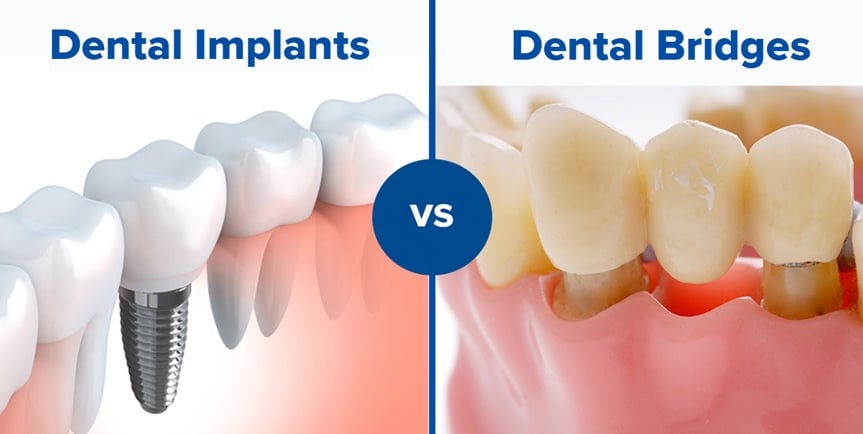
Losing a tooth affects more than just your smile—it impacts how you chew, speak, and retain your jawbone structure. When looking at replacement options, the choice usually comes down to two major treatments: dental implants and dental bridges. While one offers a standalone, permanent structural replacement, the other relies on neighboring teeth for support.

In this guide, we break down the definitive differences in cost, procedure length, and long-term health benefits to help you decide which option is right for your smile.

Our services

When is a Dental Bridge the Right Choice?

While dental implants are highly durable, traditional dental bridges remain an excellent, reliable option for many patients. If you need a faster solution or want to minimize your immediate out-of-pocket expenses, a dental bridge offers distinct practical advantages.

Why Dental Implants Are the Gold Standard for Tooth Replacement

When it comes to replacing a missing tooth, dental implants offer significant long-term biological advantages over traditional bridges. If you want a solution that mimics a natural tooth without compromising the rest of your mouth, here is why an implant is the superior choice.

. They Preserve and Protect Your Jawbone

The moment a tooth is lost, the underlying jawbone loses the chronic stimulation it needs to stay dense and healthy. Over time, this lack of stimulation leads to bone resorption—a process where the jawbone naturally shrinks and deteriorates.

A dental bridge sits entirely above the gumline, meaning it does absolutely nothing to stop this bone loss. A dental implant, however, uses a biocompatible titanium post that acts as a prosthetic root. It integrates directly with your bone through a process called osseointegration. This artificial root exerts natural chewing pressure on the bone, signaling your body to keep the jaw strong, stable, and intact.

2. Zero Damage to Healthy Adjacent Teeth

To place a dental bridge, a dentist must aggressively grind down the enamel of the two healthy teeth on either side of the gap to serve as anchors (abutments) for the artificial tooth.

Trimming down perfectly healthy, intact teeth weakens their structure and leaves them permanently vulnerable to future decay, nerve damage, and root canals.

Dental implants operate completely independently. An implant is placed directly into the empty space left by the missing tooth. It does not touch, alter, or rely on your neighboring teeth for support. By choosing an implant, you leave your surrounding teeth completely untouched and healthy.

1. Lower Upfront Cost

The primary advantage of a dental bridge is its financial accessibility. Implants require specialized surgery, components, and often bone grafting, which drives up the initial price. A dental bridge relies purely on clinical dental work and lab fabrication, making it a much more budget-friendly option for immediate tooth replacement.

2. Faster Results (No Surgery Required)

Dental implants require a healing period of three to six months for the post to fuse with the bone. A dental bridge bypasses surgery entirely. The entire process is non-invasive and typically completed in just two brief appointments spaced a couple of weeks apart.

⚠️ The Long-Term Trade-Off: While bridges save you money upfront, they generally need to be replaced every 10 to 15 years due to natural wear, shifting, or decay beneath the anchor crowns. Implants, by contrast, are designed to last a lifetime.

The Dental Bridge Procedure: Step-by-Step

Understanding the timeline helps you plan your visits. Here is exactly what to expect when getting a dental bridge fitted at our clinic:

1.Preparing the Anchor Teeth

Appointment 1 — 45-60 mins

The two healthy teeth adjacent to the gap (the abutment teeth) are gently reshaped. A precise layer of enamel is removed to ensure the new crowns fit perfectly over them without looking bulky.

2.Taking Digital Impressions

Appointment 1

We take highly accurate impressions or digital scans of your prepared teeth. These scans are sent directly to our dental laboratory, where a custom bridge is fabricated to match your natural tooth color and bite alignment.

3.Placing the Temporary Bridge

Appointment 1

While the lab crafts your permanent restoration, a temporary bridge is cemented in place. This protects your exposed teeth and gums and allows you to chew comfortably in the interim.

4.Final Fitting and Cementation

Appointment 2 — 30 mins

Once your permanent custom bridge arrives (usually 1 to 2 weeks later), the temporary bridge is removed. We check the fit, make any necessary bite adjustments, and permanently cement the bridge into place, instantly restoring your smile.

Contact

Reach out for expert dental care today

Email

Phone

asthaclinic2@gmail.com

+02534032047, 8007665040

© 2025. All rights reserved.

Astha clinic, samraat nucleus complex, ground floor, Bhabha nagar, Mumbai naka,Besides sanskriti hospital