
Root Canal vs. Extraction: Why Saving Your Natural Tooth Matters
if you are reading this while throbbing, localized tooth pain is keeping you awake, you are likely facing a tough decision. When a tooth is severely damaged or infected, your dentist will usually give you two choices: save it with a root canal or pull it completely with an extraction. At first glance, just pulling the tooth might sound like the easiest, fastest way to get rid of the pain permanently. It’s a tempting shortcut. However, removing a natural tooth sets off a chain reaction in your mouth that can impact your smile, your bite, and your wallet for decades. Let's cut through the dental jargon and look at what actually happens to your mouth—and your budget—with both options.
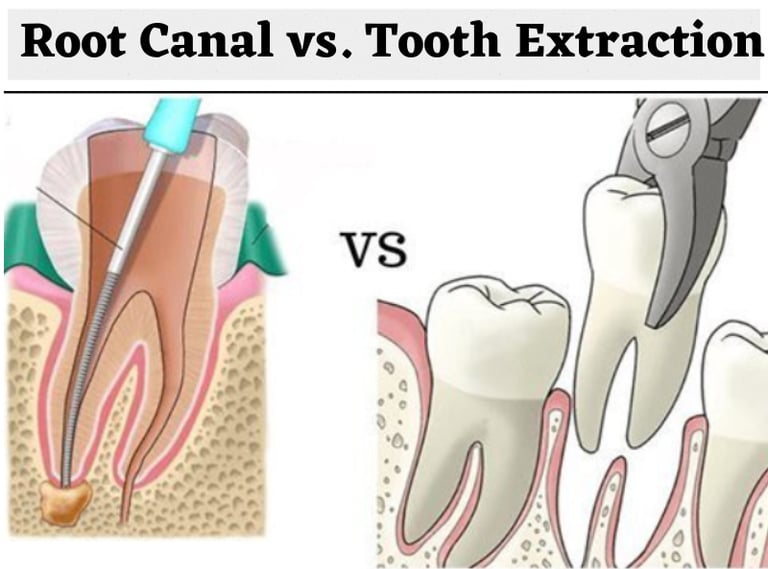
Root Canal vs. Extraction: The Quick Breakdown
Before diving into the mechanics, here is how the two procedures stack up side-by-side in terms of comfort, cost, and long-term impact.
FeatureRoot Canal TreatmentTooth ExtractionWhat Actually HappensThe dentist cleans out the infected nerve inside the tooth, sterilizes it, fills it, and protects it with a crown. The tooth stays in your mouth.The entire tooth, including the roots, is completely removed from the jawbone. The tooth is gone.The Pain FactorDone under local anesthesia. It feels virtually identical to getting a deep cavity filling.Done under local anesthesia. You feel a lot of pressure during the pull, followed by a few days of a dull ache as the socket heals.Long-Term ChangesNone. Your bite, jaw structure, and natural chewing power remain completely normal.Bone loss and shifting. The surrounding teeth will naturally tilt and drift into the empty space, changing your bite.The Real Lifetime CostHigher upfront cost, but once the tooth is sealed and crowned, it can last a lifetime with zero extra expenses.Lower upfront cost, but highly expensive later if you want to fill the gap with a bridge or a dental implant.Time in the ChairUsually 1 to 2 comfortable appointments.1 extraction appointment, followed by months of healing, bone grafting, and multiple fittings if you choose an implant later.
Why Your Natural Tooth is Always Better Than a Replacement
Dental technology has come a long way. Modern dental implants look incredibly realistic, but even the best titanium implant cannot completely replicate the form and function of the tooth nature gave you. Here is why keeping your natural tooth matters so much.
1. It Protects Your Jawbone from Melting Away
Your jawbone stays strong and dense because of the constant physical stimulation it gets from chewing. When you chew, that force travels down the root of your tooth and tells the bone, "Hey, I'm working here, keep this bone strong."
When a tooth is extracted, that specific area of the jawbone loses its purpose. Over time, the bone tissue naturally dissolves and recedes (a process called resorption). If you lose multiple teeth, this bone loss can eventually cause your cheeks to look slightly sunken, prematurely aging your face.
2. It Keeps Your Neighboring Teeth from Shifting
Think of your smile like a perfectly balanced archway. If you pull one brick out, the stability of the entire arch is compromised.
When a tooth is removed, the teeth on either side no longer have a barrier. Over the next few months and years, they will slowly tip, drift, and lean into that empty gap. This messes up how your upper and lower teeth meet, creates hard-to-reach "food traps" that breed new cavities, and can cause chronic jaw joint pain (TMJ).
3. You Keep Your Natural Chewing Sensation
Your natural teeth are suspended in your jaw by a microscopic cushion of tissue called the periodontal ligament. This ligament acts like a built-in shock absorber. More importantly, it contains tiny nerve endings that send sensory feedback to your brain. It tells your brain exactly how hard or soft you are biting down.
Implants and bridges are anchored directly into bone or attached to other teeth, meaning they lack this ligament. You completely lose that nuanced sensory feedback when you eat.
The "Cheap" Option That Ends Up Costing More
The biggest reason people choose an extraction over a root canal is the immediate price tag. A root canal and a crown require a larger upfront financial investment than simply pulling the tooth.
But here is the catch: an extraction is rarely the final step.
Living with a missing tooth can make chewing difficult and cause the shifting issues mentioned above. To fix that, most people eventually decide to get a dental bridge or a dental implant. When you add the cost of the extraction to the cost of a bone graft, an implant post, and a custom porcelain crown, the final bill is often double or triple what a root canal would have cost in the first place.
A Good Rule of Thumb: An extraction shouldn't be viewed as an alternative to a root canal. It should be viewed as a last resort when a tooth is so broken, cracked, or decayed that a root canal is physically impossible.
FAQ: Common Questions About Root Canals and Extractions
Is a root canal painful? This is the biggest myth in dentistry. The root canal doesn't cause pain; it relieves it. Because of modern numbing techniques, the procedure itself feels no different than getting a standard filling. Most of the horror stories you hear are from people remembering the pain of the infection before they finally went to the dentist.
How long does a root canaled tooth last? With proper brushing, flossing, and regular dental cleanings, a tooth saved by a root canal can easily last the rest of your life.
When is an extraction actually necessary? If a tooth has a fracture that goes deep below the gumline, or if the tooth structure is so severely decayed that there isn't enough healthy bone or enamel left to support a crown, saving it may not be an option. In those specific cases, an extraction followed by an implant is the healthiest choice.
If you are dealing with severe tooth pain, don't wait out of fear. Schedule an evaluation with your dentist to get an X-ray. They can show you exactly what is happening under the surface and help you make the best plan to save your smile.
Contact
Reach out for expert dental care today
Phone
asthaclinic2@gmail.com
+02534032047, 8007665040
© 2025. All rights reserved.
Astha clinic, samraat nucleus complex, ground floor, Bhabha nagar, Mumbai naka,Besides sanskriti hospital